Hey Kids, Comics #62 - Deconstructing Comics: Stand By Me

A comic book hero’s adventures are little more than a series of fist fights without a good supporting cast.  It is the ordinary, and even extraordinary, people in the wings that add flavor, anxiety, and a touch of the real world to the life of the super-hero.


In the fourth installment of this arc super-friends Andy and Cole hang out with the folks who hang out with their favorite super-heroes.  And Frank Anderson, Jr. joins the fun!  Not the love interests or significant others, but rather their friends, co-workers, confidants, and assistants who are the subject of this episode.  From famous butlers to traveling companions, friends keep a super-hero grounded, focused, and sometimes even sane.  

Plus our special guest is none other than our good friend Frank Anderson, Jr. who stopped by JediCole's studio to share a mic and get in on the comic book super friend action.


JCU Sunday Funnies #26


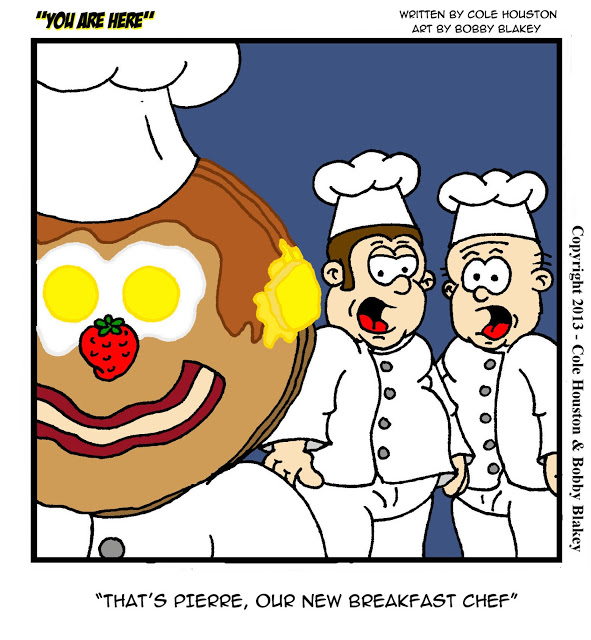
A brand new cartoon will be joining You Are Here most Sundays, Open Season.  Launched to facilitate cartoons written by others than myself (and sometimes, though not always drawn by others than Bobby), this new cartoon will appear as part of JCU Sunday Funnies whenever a new cartoon is available for publication.  Bobby Blakey premieres the series with this great cartoon...


Want to see Bobby Blakey's art and his own humor including the newly relaunched Last Stop?  Check out six years of the strip plus new material every week right here!

Hey Kids, Comics! #61 - Deconstructing Comics: To Prove a Villain

What better way to launch the second part of “Deconstructing Comics” than to quote the Bard?  Much akin to Shakespeare’s most sinister characters, the super-villain is often possessed of ambition that robs all nobility in the pursuit of personal gain.  The villain is the focus of this issue of the arc.


Andrew Farmer and Cole Houston enter the lion’s den as the in-depth exploration of the super-hero genre continues.  The driving forces behind the evil machinations of comic book villains are as varied as the costumed criminals themselves.  Be it fortune, revenge, world domination, or insanity, what moves men and women to embrace a life of crime will be questioned, debated, and examined in this wicked issue of Hey Kids, Comics! 

Prepare to gaze into the abyss!


And find out what this guy has to do with the subject, too...


A Long Way to Go For a Joke: Behind the Scenes of "You Are Here"

Twenty-five weeks ago a one panel cartoon series premiered on this website under the banner of JCU Sunday Funnies.  The cartoon, You Are Here, was launched to make use of some concepts that were at least 20 years old along with a variety of new ones that have come up along the way.  But for the tireless efforts of Texas-based cartoonist Bobby Blakey, however, this series would never have gone further than my Ever-Ticking Brain.  Instead a cartoon idea sent to Bobby on a lark resulted not only in a means to bring some dusty ideas out of obscurity, but to inspire an ongoing series with more concepts in some stage of development than have been published to date.  In other words, you can look forward to more You Are Here comics for many more months to come.

As outlined in the first JCU Sunday Funnies post, this cartoon was initially conceived as a potential weekly strip for the Oak Cliff Tribune.  In the interest of having a “creative buffer”, the strip would not be proposed until at least three months worth of cartoons had been completed.  While I did manage to conjure up about 20 ideas in advance and even commit a few to paper, the project never gelled, largely due to not being particularly thrilled with my own art.  The original concept sketches and finished drawings were remanded to my “life’s papers” files but never forgotten.  So when the cartoon idea based on The Flintstones was so masterfully created by Bobby I decided to approach him about producing a series.  That this occurred has certainly been borne out over the last several months as week after week You Are Here remains a reliable feature of this website.  On the occasion of reaching 25 weeks of humor and art joining forces I thought it might be fun to show some of the process that has gone into brining you the focus of JCU Sunday Funnies since its inception.

Out of the Past and Present
With an available backlog of concepts to follow the first new idea in two decades it seemed like a good idea to move forward with You Are Here as a weekly feature on the JCU site.  In order to leave the door open for other such cartooning pursuits down the line I chose to publish under the JCU Sunday Funnies imprint.  This turned out to be a shrewd maneuver as there will in fact be a new cartoon in the mix next Sunday.  At the time I was trying to be forward thinking but also wondered if I could perpetuate this new comic for more than six months.  None the less I decided to have faith that I could have a new concept cross my thoughts often enough to maintain the feature and bolster the backlog of ideas I had come to call “The 20  Year Club”. 

I need not have worried, however.  After an exhaustive search of my files I was able to dig up my original sketches for many of the comics that have been seen thus far or are coming in the near future and send them to Bobby along with notes on what I had in mind.  Within days his first new endeavors began to arrive in my email inbox.  The first two cartoons I received would become You Are Here #2 and You Are Here #7, both based on older concepts and sketches.  While these and other cartoons were rolling in two at a time I was coming up with new ideas and sending them to Bobby as well.  As a result, half of the first ten cartoons to be produced at full were based on brand new ideas that had come to me since the one that started it all.  As of this writing new ideas finalized into cartoons have been running roughly neck and neck by volume with the volume of the new exceeding that of the old by only two or three cartoons.

Varied Visions
From the outset the process involved in bringing my concepts to life for this series has remained largely unchanged.  Initially I sent Bobby scans of the original art from years past for as many of the cartoons as I could find in my files along with one or two concept sketches for new ideas.  With all of that in place I had the freedom to dig around in hopes of finding more of the art.  In the mean time Bobby had set to work on churning out enough of these comics that by early April I felt it was safe to begin weekly publication.  It was during this time that I began to realize something I would not define at full for some time, that as a cartoonist I am a much better illustrator.  Teaming up with Bobby on You Are Here brought this fact out again and again.  A prime example of this was the “honey bear” cartoon in which a bear dons a beekeeper’s protective gear to have a better shot at the honey he craves.  My 20 year old drawing had a cartoony bear but rather realistic bees watching over the hive.  When I received Bobby’s finished work I was taken aback by the anthropomorphic bees in the cartoon at first.  I quickly realized that this was as it should be, this was a cartoon after all! 

The bees and bear cartoon was not the only one over the months of the collaboration thus far in which Bobby took me by surprise in altering the images from my rough sketches.  The Turtle Homeowners Association was definitely one that falls into this category.  In my sketch the turtles were, well, turtles.  They walked on all fours and were only cartoon-like in their smiles and the vacuous stares of the representatives of the Association who were plaguing the old turtle.  Oddly enough I had talked with Bobby at a convention a few days before he completed that cartoon and he described envisioning one of the turtles holding a clipboard.  Despite this, I was still initially surprised by his take on the concept.  Mind you, it was a pleasant surprise.  Again I was confronted with the realization that as a cartoon the characters far much better in a cartoon form rather than a semi-realistic form. 

If you have ever met Bobby or heard him speak of his work on Hey Kids, Comics! (check out that show here) then you know he will always undersell his art.  More often than not when he sends two to four finished cartoons my way he will point out that he can change anything that is wrong or just start over from scratch.  In fact there have been so very few running changes to his work that I question his questioning of his skill!  In the case of the honey bear I had him change the color of the hatband to make it read more like a beekeeper’s helmet than a park ranger’s hat.  “Brush With Death” was reworked to make the placement of the man’s head seem more in line with his reflection and I had to insist that the nipples on Kermit and Miss Piggy’s baby be removed.  A Muppet with nipples just read too creepy for the already creepy image.  In fact the only cartoon in the series to date that had to go back and forth between us was the navy man.  That was an unusual one in that it was the only one with color in the rough sketch (added with a highlighter) and the only one where getting the color right on the final image was at issue.  Initially the hue utilized played was too light for those who got to see it in advance to read as navy.  A quick darkening of the shade brought the character’s tone more to what was expected by most without being too dark to see the features. 

This hue just did not convey navy blue.
The character to the right of the panel was the only other running change.  I felt perhaps his reaction was a bit too extreme.  Bobby graciously redrew him with just a smile and I shopped both versions to those who had helped work out the color pallet.  Unanimously, it turned out, the opinion was that the shocked expression sold the joke far better than the relaxed version.   In many ways that cartoon was a valuable lesson to just let the master do his magic.  That is why I elected to work with Bobby in the first place.  As an artist his sense of the range of expression is ideal for a comic of this kind.  In fact that ability came to bear most fully in the Vulcan Surprise Party.  The level of dispassionate indifference conveyed in the faces of the birthday boy and those throwing his party sells the joke far more than the equally emotionless dialogue!


Keeping Fit
One of  the biggest challenges on both sides of the collaboration has been fitting everything into the panel.  Early on the format was somewhat new to me and my ambitions in the cartoons concepts often exceeded the space available.  The Clown Compact cartoon brought that to my attention.  The initial concept included three classes of automobile, Compact, Sub-Compact, and Clown Compact.  Space constraints within the square panel forced Bobby to edit the concept and let the dialogue sell the joke as much as the image.  Again his sensibility was right on target and the cartoon worked in spite of being down one car model. 

The ham-fisted attempt to convey the idea behind the Clown Car cartoon.

Here and there certain elements of my original concepts have had to be trimmed or eliminated outright.  Bobby has been very good about consulting me before making drastic changes, so to say I have been most pleased with the series to date is something of an understatement.  In the case of the elephant and the game show the space constraints were rather unique to the cartoon.  Every element originally envisioned was there, save one.  In the original concept the game show host’s dialogue was to be under the cartoon and the name of the show, which was not part of the original 20 years ago, was to be in lights above the contestants.  Space dictated that a change in plans must be made and Bobby took the liberty of putting the dialogue in a word bubble and captioning the cartoon with the name of the show and calling it, “Everyone’s Favorite Game Show”, a change that helped drive home the joke far more effectively.


As he churns out more and more cartoons for this series, Bobby has adjusted his style in such a way to accommodate some of the busier designs I send his way.  Perhaps the greatest example of this was the very demanding Richard Scary cartoon.  Every element of the original concept sketch but one, the lower half of the composition, appears in the final work.  Due to space constraints he was forced to jettison the flat tires on the Apple Car as well as lowly worm’s trademark hat laying on the pavement.  Not vitally important elements to be sure, and in the end his blocking of an incredibly busy arrangement of characters and ancillary aspects, not the least of which is the Crime Scene tape, makes that cartoon one of his most outstanding creations to date and a personal favorite.

Artistic License
Something else Bobby does quite well is to add his own very Bobby Blakey flourishes to the cartoons.  When the Monkey’s Pa cartoon arrived I did not realize at first that he was utilizing his movie reviewing gorilla, Doug, as the monkey in question.  This was not at all surprising when I considered that Bobby has a tendency to sneak his original characters into the artwork of others whenever he is a participating inker in “Finish It! Finish It!” at All-Con.  When I sent him the Earth Warning Label concept sketch I deliberately designed an original alien for the cartoon so as not to seem to expect that he use one of his characters from Last Stop.  Despite my efforts he managed to replace my creature with Klunk from his ongoing web comic.  Nothing like a shameless self-promoting plug, I say!


There have been other additions to the original composition as presented along the way as well.  TheUgnaughts cartoon originally featured only the dismantled Tin Man in a crate and a pair of the diminutive porcine workers from Bespin.  Bobby recalled that this denizen of Oz would be incomplete without his axe and also presented a rather gruesome take on the character’s greatest desire with a disembodied heart laying on the conveyor belt!  At first I felt that may play a bit too extreme, but then thought better of it and let the cartoon publish as presented.  I had learned to stop second-guessing my artist. 

The personalization of the “answering the fax machine” cartoon was another way in which Bobby brings more to the table than just his art.  The heading, “Message from JediCole”, on the fax page emerging from the character’s mouth just added an extra element to the joke.  Similarly the tie, clipboard, and glasses for the turtles in the aforementioned turtle cartoon made the two pristine turtles seem only the more officious.  Then there was a visual element that Bobby added to the Brush With Death that was nothing short of brilliant!  In my original sketch for this concept from 20 years back and in its replacement (the original eludes me to this day) I simply had the Grim Reaper and the pajama-clad character busily cleaning their teeth.  Bobby shrewdly realized that, absent saliva, Death’s toothpaste would not foam up like that of his living counterpart.  That he made that distinction clear so simply in his drawing really added something special to the overall joke. 

Two by Two
One thing that I have learned as I have been working with Bobby on this cartoon was that he draws and submits the new comics two at a time.  While they tend to arrive to me in twos and fours I had never made the connection as I am usually too thrilled to see what he has done with my concepts.  While I have received as many as six in one submission, Bobby generally has three to four times that many concept sketches and descriptions on hand from which to choose his next endeavor.  A full year’s worth of cartoons have been published, completed, or roughed out at this point and every time I feel that this will protect me from inevitable creative doldrums, two or three more concepts rattle out and are sent to my self-deprecating artist friend. 

My original concept art for the woolly mammoth cartoon.

Somehow I have yet to burn Bobby out on this series despite sending so many ideas that he would have to devote a month to catching up were we not so far ahead of the publication schedule on a fairly constant basis.  In fact the scheduling of any given cartoon is rather fluid as I will line up the completed work in an order that I like only to have two or four more finished pieces arrive in my in box that have me rearranging the whole schedule to move new favorites to the top of the queue!  As I was writing this very article I got word that two more cartoons were in the works and would be in my hands very soon.  This means that I will now have eight cartoons completed and will likely rearrange the present schedule yet again depending on which of the more than 25 concepts he has at his disposal he has chosen to tackle.


A sneak preview of one of the new cartoons mentioned above.

It Has a Name
As this glimpse into what it takes to bring you the weekly gags of You Are Here concludes I wanted to share a little inside information from the production, specifically the definition of a common aspect of Bobby’s art for this series.  I am speaking of an expression that has become so prevalent that a term had to be coined to describe it…the Blakey Gawk! 


The Blakey Gawk is one of my favorite aspects of You Are Here as it turns any given character in the scene into an instant straight man.  While I realize that such an expression of shock or dismay is likely one of the more universal tools at the disposal of cartoonists, the way in which it can sell my jokes makes it nothing short of remarkable.   From exasperated game show contestants to surprised aliens to even Muppets, the Blakey Gawk has helped convey all a variety of reactions to the absurd notions presented in these cartoons.  And from this moment forward you too will refer to this expression as the Blakey Gawk.  It will certainly occur often in the future unless this article has made the intrepid artist self-conscious about that aspect of his work.  Even still, there is at least one example of the gawk in an as yet unpublished cartoon.  Below is a sneak peek at that cartoon that does not give away the joke, just its Blakey Gawk! 


Now you have some insight into what it takes to bring you JCU Sunday Funnies each week.  I sincerely hope that everyone who reads this article has enjoyed at least one if not more of the cartoons in the series to date.  I have found that different cartoons speak to different people, illustrating the diversity of appeal to the ideas that rattle out of my head at an alarming rate.  I certainly look forward to continuing this series with the help of Bobby’s dead-on artistic interpretations.  I will also be expanding the Sunday Funnies  lineup starting next week with an occasional second feature.  


From the outset of You Are Here I have had a variety of ideas suggested to me by Mrs. JediCole and others that have not been introduced into the series.  The reason for this is simply because I wanted to maintain a kind of creative ownership of the cartoon, to be its sole writer.  This has resulted in some really funny concepts going the way of my 20 year old ones, falling into unknown obscurity.  Since Bobby helped rescue my old ideas from such a fate I have determined to launch a new recurring series that will showcase the art and/or writing of other creators.  Look for the first cartoon of the new series to accompany You Are Here #26 next Sunday!

Hey Kids, Comics! #60 - Deconstructing Comics: I Need a Hero

Welcome to the first issue of an exciting new story arc in which Andrew Farmer and Cole Houston take on the daunting task of exploring the minutia of the super-hero comic.  To kick off the series the hero is put under the microscope and examined in intimate detail.


What possesses men and  women to don tights and utility belts, to devote time and money to the pursuit of justice?  How and why does the super-hero become a vital part of crime fighting and national or even global defense?  How has the role of the hero evolved to remain topical to modern audiences?  These are some of the questions that will be pondered as a myriad of heroes are cited and examined by your inquisitive hosts.


Marketability Trumps Poignancy: The Phil Coulsen Story

I never watched Firefly when it was on the air.  I never watched it in reruns or on DVD.  In spite of this fact I did wind up seeing Serenity and found it both approachable for the unindoctrinated and  quite enjoyable.  One thing that struck me was the on screen demise of one of the series’ most popular characters.  A writer should always be willing to sacrifice a character here and there but how that loss is approached makes all the difference in the world.  The death of Wash was meaningful in the context of the film and, by all accounts, equally devastating to fans.  The death of the character served a purpose in the story while also shaking the fan base to its core.  Wash’s death meant something! 


This illustrates what happens when a breakaway character becomes the ideal sacrifice on the alter of story craft.  Audiences become absolutely livid!  Be it a striking figure seemingly meant to carry a narrative to its conclusion (think Ned Stark in Game of Thrones) or the affable Wash of Firefly,  one of the most compelling actions a writer can take is to allow a favorite character to be killed.  Done right such deaths are as moving as they are shocking.  And such was the case when Agent Coulsen cashed in his chips at the hands of the evil Asgardian trickster, Loki.  At least that is what we, and the would-be Avengers, were meant to think!


Phil Coulson, agent of S.H.I.E.L.D., quietly became part of the Marvel cinematic universe in 2008’s Iron Man and as the initial face of S.H.I.E.L.D.  Coulson’s strong supporting presence in Iron Man 2 (2010) and Thor (2011) helped cement the character’s place in the hearts of Marvel movie fandom.  A pair of “Marvel One-Shot” short films which accompanied the Thor and Captain America home video releases, elevated Coulson’s popularity to cult status.  It is little wonder that his appearance in The Avengers was met  with glee equal to the shock and sadness at his apparent demise.  While wholly unexpected, Phil Coulson’s death in the line of duty presented one of the most compelling scenes in a comic book film.

"He's 'mostly dead'!"
In common with most fans of the Marvel franchises, I was taken aback and saddened by Phil Coulson’s death.  However, unlike so many it would seem, I was able to let him die a hero’s death and become something even more important to the greater cinematic Marvel universe.  There was a reason he died in action and that was illustrated profoundly in Nick Fury’s subterfuge.  Not above using any means necessary to get what he wants (see the short film The Consultant for a perfect illustration of this mentality), Fury had no qualms about retrieving Coulson’s prized Captain America trading card collection, smearing it with the agent’s death blood, and throwing it in the faces of his band of heroes.  While Fury’s action was less than noble, it was a necessary means to an end that martyred Coulson in the eyes of the Avengers, most especially Tony Stark.  The now active team was imbued with a drive that made their name quite literal as well as figurative.  When Phil Coulson died he gave purpose to Earth’s Mightiest Heroes that led to the undoing of the grand schemes of Loki and Thanos.

"Tis but a scratch!"
But that sort of thing simply won’t do, will it?  Fan outcry was naturally strong for the beloved character.  How could they build up Phil Coulson, make us love him, then simply let him get impaled on Loki’s spear?  It was an outrage!  At least that was the case for many fans of the character.  Mind you, I am a huge fan myself, but I am also a huge proponent for letting go when the death of a character drives the story or makes sense.  I wrote a popular article on the subject for the United States of Geekdom some  years back that addressed fandom and letting dead characters remain dead if their deaths were meaningful (see Darth Maul Must Die, Boba Fett Must Live here) and find myself walking a similar path in regards to Agent Coulson.  It strikes me as fairly obvious that Marvel Films heard fandom’s lamentations and accordingly caved in on the apparent demise of the popular character, thusly undermining a vital scene The Avengers.


Cowing to the outcry, Marvel quickly made a maneuver designed to placate the fans.   An announcement was made that Coulson actor Clark Gregg would voice his character as both the self-same S.H.I.E.L.D. agent as well as the principle of Peter Parker’s high school in the animated series Ultimate Spider-Man.  This news struck me as the “ultimate conceit”, but that would not be enough.  Hot on the heels of the cartoon came the word that Agents of S.H.I.E.L.D. was being developed for television by no less than The Avengers writer/director Joss Whedon.  When I first heard about this I was no less excited than any Marvel movie fan, though I was hopeful that the production would be purpose built to take place before the events in the film that saw its star agent meet his demise.  But alas, Phil Coulson is just too important a character to allow to rest in peace!  In a move that is all too reminiscent to the retooling of the end of the G.I. Joe animated movie of 1987 that rescued the Joe’s leader, Duke, from the jaws of death with a simple tacked-on announcement that his death scene was not quite as mortal as it seemed (“Doc just called.  Duke’s gonna’ be okay!”), it has been made clear that the television series will in fact take place after Coulson’s apparent demise. 


Am I sad or angry about this?  Not necessarily.  More bemused.  It is painfully obvious to me that Agents of S.H.I.E.L.D. stands a better chance of achieving an audience from the outset with the presence of an amazingly popular character like Agent Coulson.  Even if the first episodes or even full season proved a disaster (which it won’t), Coulson would bring in fans for at least a few episodes.  There are decided advantages to having the character headline the show, familiarity being foremost.  I recognize this and embrace it as a Nick Fury-esque means to an end.  What bothers me is that the necessity of bolstering the success of the television venture comes at the cost of something that was once meaningful.  No possibility suggested by fans that I have yet encountered (high tech medical capabilities on the Helicarrier, Coulson was really a Life Model Decoy, etc.) does anything to soften the sense that Phil Coulson’s death was meaningless in every conceivable way.


I will allow that Fury lied about the trading cards being on his top agent’s person when he was killed, however I cannot let that act stand as an excuse for Coulson’s miraculous recovery from a mystical weapon through the heart.  The principle reason for this is not just that it undermines the poignancy of the character’s death scene, but also the underpinnings of the future of the Avengers.  Even if it came to light that the trading cards were not actually in Coulson’s pocket when he was murdered, that he was decidedly not murdered after all would be an affront to every single member of the team who, in many ways, gave their all and more in Coulson’s name.  While no one need ever know of Fury’s dirty little card trick, it would be a lot harder to simply wave away the fact that a supposedly dead man is alive and well and “Oh, we forgot to tell you, Phil’s gonna’ be okay!”   There is no approach that can be made to Coulson’s survival that will ever work for me in the context of The Avengers.  Even with the conceit that in comics no one ever really stays dead for long, nothing presented tomorrow when  Agents of S.H.I.E.L.D. premieres will ever be good enough to undo the damage done to the plot of the feature film.

"I got better."
That said, I am very much looking forward to this show which promises to at least do something I hoped it would - act as a launchpad for Marvel Comics characters for potential use in future movies.  Knowing that Joss Whedon is directly and intimately involved also adds tremendously to the shows personal appeal.  There is some hope that the "super-hero" tantalizingly previewed in the earliest commercials may in fact turn out to be Luke Cage pre-Power Man.  There is little doubt that the show will be nothing short of amazing and perhaps in time I will be less and less bothered by the fact that it took crowbarring life into a meaningfully dead character to make the whole thing happen.  Time will tell.


On a final note, Firefly/Serenity fans can at least hang hopes on the triumphant return to life of one Hoban “Wash” Washburne should that property ever be revived for the screen, big or small, since a precedent has been set!

Discover the Texas Convention Scene at Convention Awareness Project - Texas

If you happened to be out in Grapevine on September 21 at the DFW G.I. Joe and Action Figure Show II and saw me there at the table of The JediCole Universe then you might have heard of the sister site, Convention Awareness Project - Texas.


You might also have heard that I was fresh out of postcards for the convention site.  Well if you are keen on finding out about every convention of fan interest in the Lone Star State in a one-stop-shopping kind of format then visit CAP-TX by clicking here.

The above link will take you to the 2013 convention list post, but the site often has spotlights on upcoming shows with interviews with the people who put them on as well as other feature articles, so be sure and check out the main page often.  2014 convention listings will begin to appear in November 2013 as well!

Convention Awareness Project - Texas reminds you...


You Can't Go If You Don't Know!

Who Do You Love #2 - Amblin' Love

It has been over two years since the first Who Do You Love? was published on this very site.  It has been almost a year since the dreadfully overdue second episode was recorded (which will explain any references that seem dated), but it is finally happening! 


With apologies to my guest, Rick Gutierrez of The United States of Geekdom, The JediCole Universe is proud to present the return of this personalized podcast.  And with this episode I welcome Rick and the subsequent discussion about producer/director Steven Spielberg.  Confronted with having to choose just one topic of discussion, my guest this outing focused on one of the most talented and successful creators in the film industry.  Enjoy this personal journey as Rick explores why Spielberg was the answer to the question, "Who do you love?"


Want to be a guest on a future episode?  (They will be published much closer to the date of the recording I promise!)  Send me an email with the subject "Who I Love" and your single topic of discussion.  You might be the next featured guest on this show!

Hey Kids, Comics! #59 - Creator Spotlight #2: Good Bill Willingham Hunting


The Hey Kids, Comics! “Creator Spotlight” is back and shines on a writer and artist with a lengthy and, literally, storied career.  You have heard his name mentioned here many times in the past so he was an ideal choice for this recurring feature.  And of course we are talking about none other than former Dungeons and Dragons game book illustrator Bill Willingham! 


From Elementals to Fables, Andy and Cole have plenty of ground to cover with the multi-talented Bill Willingham.  His career in comics has spanned decades and encompassed works for well-known and obscure publishers alike.  Discover just exactly what makes our featured creator a noteworthy contributor to the world of comics as we are joined this week by fellow Willingham fan Steve McCauley.


Hey Kids, Comics! #58 - What? No Pictures?

It is Hey Kids, Comics! time again and this time your hosts have a little something different in mind.  Comic books are great but some people want a little more, especially the publishers!  Why stop at serialize graphic fiction when you can team up with various book publishers and create novels and anthologies of everyone's favorite comic book characters?  At intervals over the years, from the illustrated 1947 novel The Adventures of Superman straight through to 2013's novelization of Iron Man: Extremis, comic book themed books have been an important sub-genre of the industry.


This week's exploration of the world of comic book-based prose brings special guest Matt "Starman" Morrison to the mix with some great insights and personal experiences with such books.  Discover the non-illustrated world of comics with this unusual picture-free issue.


BONUS!!  Thanks to next week's special guest, Matt Morrison, Cole was pointed in the direction of some YouTube posts of the songs from the Justice League record album referenced in this week's issue.  Give a listen here if you want to hear Batman's awkward voice.  You can also hear Superman attempt to invent rap!

Whadjathink? - The World's End

Drink Like There's No Tomorrow


Welcome to the latest edition of Whadjathink? with Catherine Houston and Bobby Blakey.  This time they are joined by the JCU's own Andrew Farmer for a critical pub crawl through the final chapter of Simon Pegg and Edgar Wright's "Cornetto Trilogy".   

As always this episode will be replete with spoilers so it would be a good idea to wait until after you have seen the movie to listen to the show.  Unless of course you want to know everything going in, that is certainly up to you.  Self-determination is what it's all about, right?  

SPOILER ALERT!

The Apocrypha #5; Classical Cars (or How I Learned to Stop Hating on Disney/Pixar’s “Cars”)


by JediCole

Sometimes a conversation with a friend about nothing in particular can prove the catalyst for something cathartic.  Such was the case when I was talking with Andrew Farmer prior to recording an episode of our weekly series Hey Kids, Comics! about a month ago.  Perhaps due in no small part to the impending release of Disney’s latest bid to milk an inorganic cash cow, Planes, the personally reviled animated feature Cars insinuated itself into the conversation.


Reviled may be too harsh a word to apply to a film I have never seen and have little inclination to ever see should providence insure I must never be forced into such an unexpected screening.  More accurately I find no appeal in the concept beyond an opportunity to extrapolate on the logic-threatening nature of a world peopled by autonomous automobiles.  I have certainly delighted in my exaggerated questioning of the physiology and life cycle of such entities, not to mention the patently impossible nature of the mundane aspects of their day to day lives such as construction and governance.  But such explorations into the minutia of what is wrong with the core concept behind Cars is not the purpose of this article.   In fact my intention is not to further vilify the fuel-injected denizens of Radiator Springs, but rather to deify them.
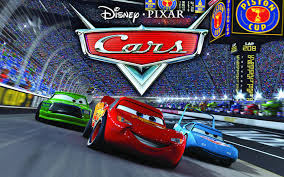

What came about in this pre-show conversation was the inspiration for two related features for your enjoyment here at The JediCole Universe that share a common thread.  While questioning the nature of the airborne in a realm of largely earthbound creatures as suggested by the latest incarnation of the Cars franchise, I began to see a previously unrealized connection between those animated autos and the Autobots.  Could Mater have been a rejected product of Cybertron?  Is it possible that the Transformers represent the pinnacle of evolution for the cars, trucks, boats, and aircraft of the realm portrayed in CG animated form on the silver screen?  Was there a connection between these two portrayals of anthropomorphic vehicles?  This certainly bore further investigation.
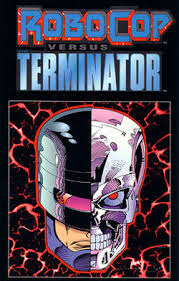

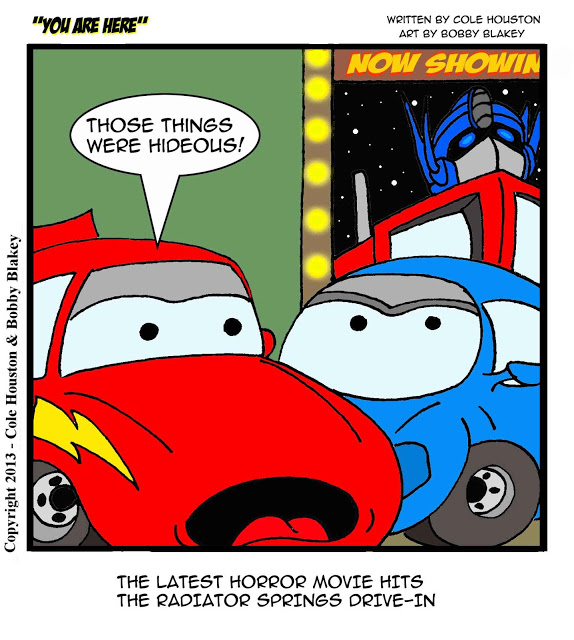
Initially my thoughts took me to an inevitable place as we were warming up for a discussion of comic books, the crossover!  What has become more a part of the comic publisher’s bag of tricks than the mash up of one property versus another?  Granted, this chestnut existed on screen long before it became a staple of printed serial fiction (think Frankenstein Meets Dracula; c. 1957) and persists to this day, but comics have held fast to this technique as well.  From the 1976 treasury-sized Superman vs. The Amazing Spider-Man to the trend-launching Aliens vs. Predator, the cross-property crossover has become almost commonplace.  Suddenly the thought of a Cars vs. Transformers mini-series seemed at least a possibility.  1994 saw the highly improbably Archie Meets the Punisher after all!  But such a cooperative effort between the two hit properties is  unlikely given that, to my thinking, Lightning McQueen and company would perceive the abilities of the Transformers as something akin to a human being watching another person turn himself inside out and utilize his kidneys as boxing gloves or something equally disconcerting.  Thus was this week’s JCU Sunday Funnies inspired. 
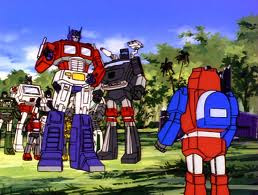

Absent such a crossover event my Ever-Ticking Brain was left to further struggle with the nature of Cars and the tantalizing potential of tying their universe to that of the Decepticons and Autobots.  Oddly enough I had never been as bothered by the Transformers’ bizarre Energon-centric culture or even that alien automatons should by miraculous coincidence happen to passably resemble the creations of Earthly engineers and designers.  Somehow this always made a perverse kind of sense in the way that McQueen and friends failed to do in any conceivable fashion.  Perhaps this was a product of the Transformers being presented as robots (albeit in disguise) rather than some sort of established civilization with no adequately explored origins.  And then I found the reconciliation that had long eluded me.  I found a way to make sense of Cars(and even Planes) in a way that meshed perfectly with the self-aware car/boat/airplane/tank/triceratops-shaped androids of Cybertron.  A discovery that would elevate Lightning, Sally, Mater, and even Ramon to godhood.


Simply put, Cars is the Bullfinches Mythology of  the Transformers universe.  The plots of the three feature films and all other video productions and books produced for this franchise are simply the recounting of the ancient myths and legends of Cybertron.  In the classical civilization of the Transformers, early robots worshiped a pantheon of god-like transportation methods from the young demigod Lightning McQueen to the Titan known as Finn McMissle, aspects of their world were embodied by their deities.  While this once thriving religion is now reduced to folklore, Autobot and Decepticon alike have imprinted on their memory banks the adventures and machinations of the gods and heroes of a bygone era.  The archaic tales are not only preserved but are also part of the very fabric of Cybertronian society to this day.  The constellations Ripslinger, Sarge, Mater, and Crabby the Boat are familiar to even Dinobots.  The etymology of the word “shiftwell” is traced to the godess Holly Shiftwell of Transformer myth.  Some Decepticons have even been known to have images of such legendary figures as Chick Hicks painted on their fuselage before going into battle.  These cited examples are just a few of many that illustrate the influence of the Classics on contemporary Transformer culture. 
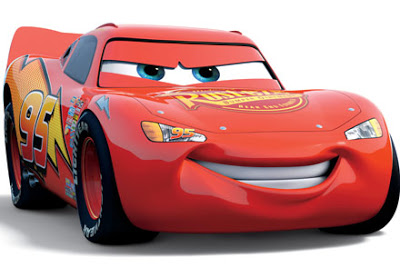

So it is with no shortage of amazement I find myself at last discovering a way to reconcile all of my previous doubts concerning the viability of the world in which Cars takes place.  By couching their universe in the antiquated past of that of The Transformers I have reconciled one of the most troubling pop culture mysteries that have plagued me in years past.  As the legends of Cybertron I find comfort and reconciliation in the existence of Lightning McQueen and his ilk.  Furthermore I can lend a further depth to a society of robots that took their ongoing struggle to the very doorstep of mankind, bringing with them a piece of their ancestry.  So it was that these myths, altered and made more approachable to humans, would give Walt Disney Productions a surefire hit with kids and adults.  A hit that I can accept more readily than I ever imagined possible.


For the further edification of the reader The JediCole Universe is proud to offer an abridged glossary of the Cybertronian pantheon as translated from Sproketus’ The Motorworks and Days.

Lightning McQueen – Demigod.  A common Car elevated to the pantheon due to his heroics and embodiment of speed and perseverance.  God of fuel-injection credited with bringing six cylinders to the world.  Considered father of the Nascardian gods.  
Classical Analogue: Zeus, Prometheus, and Heracles

Sally Carrera – Goddess of beauty and justice.  Wife to Lightning McQueen after his ascension to the throne of Nascardia.
Classical Analogue: Hera and Aphrodite

Mater – God of maintenance.  Mater was the ever-present aide to the higher pantheon.  Part healer, part servant, part engineer. 
Classical Analogue: Hephaestus

Sarge – God of war.  The gruff and officious patron of both primeval Autobot and Decepticon factions. 
Classical Analogue: Ares

Holly Shiftwell – Goddess of weaponry.  Credited in myth with teaching Transformers to create missiles, lasers, and rocket-propelled fists.
Classical Analogue: Diana

Leadbottom – God of agriculture.  The cropdusting plane brought plant life to prehistoric Cybertron for the benefit of earthmoving and land-clearing ancient Autobots.
Classical Analogue: Ceres

Ramon – God of style.  In the ancient world it was believed that Ramon transformed Transformers from bleak, primer-gray entities to the stylish multi-colored robots seen to this day.
Classical Analogue: Apollo

Ripslinger – God of the Overworld.   In the traditions of the ancients, upon their demise Transformers would “roll out” of the physical world and their core programming would download to the Overworld, an afterlife realm for robots.  While often depicted as vile in the legends, Ripslinger was the caretaker of the realm of the deceased and determined which level of the parking garage like afterlife Cybertronians would occupy for eternity.
Classical Analogue: Hades


Cole "JediCole" Houston is a freelance Texas-based writer and recovering Cars hater who feels that the autocentric franchise is the bone claws of Disney/Pixar.  Through intense study of Cybertronic folklore he has come to the realization that it could be worse, Disney could green light Percy Jackson and the Lightning McQueen Thief, an ill-advised meshing of the concepts expressed above and Grand Theft Auto.
Hey Kids, Comics! #57 - HKC! Team-Up #2: The Avengers

Earth's Mightiest Heroes take center stage as "HKC! Team-Up" returns.  As the biggest and best known super-hero team at the House of Ideas, it was only natural that the Avengers would follow the Justice League for in-depth discussion.

With an ever changing roster who are granted lifetime membership, this will be a challenging group for Andrew and Cole to tackle, but they are certainly up to the task.  From the original gathering of heroes with the intent of foiling Loki's schemes to the modern, often dark, incarnations of today there is a lot of ground to cover.  So pull up a seat and give a listen to a brief history of the Avengers, Hey Kids, Comics! style.


Max and Me - A Tale of Jabba's Palace

1983 marked the beginning of a love/hate relationship that perpetuates to this day.  And it began on a fateful summer day among friends in a movie theater in Duncanville, Texas.  It was at the day’s first screening of Return of the Jedi on opening day.  The day a silly blue elephant appeared in a Star Wars film and left me in a conflicted state.   While there was as much to love about the final chapter of George Lucas’ star-spanning history of some distant intergalactic realm as there was to hate (think Ewoks), the fulcrum upon which that dichotomy pivots in my view was none other than Sy Snootles’ keyboardist!


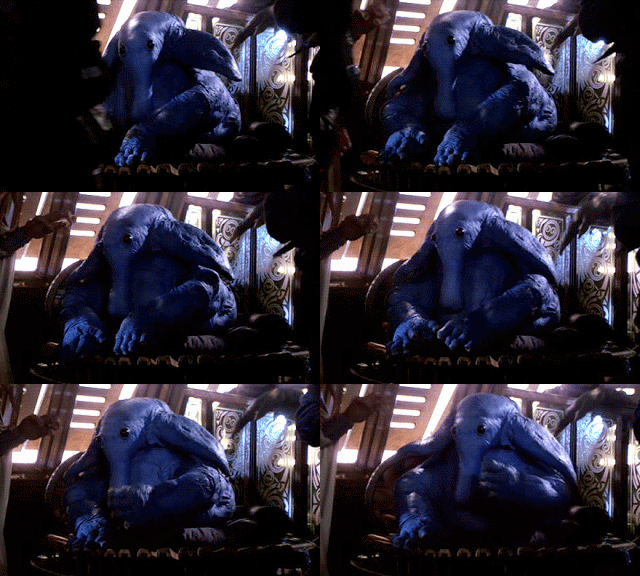
Max Rebo, accompanist and band leader (though at the time his band was more a combo), instantly found a special place in my heart and mind when it comes to the Star Wars saga.  In an attempt to go above and beyond when it came to peopling a scene with bizarre aliens, George Lucas and company cast about in every possible direction for unique designs. Perhaps the sting of using off the shelf masks and cheesy costumes to flesh out Mos Eisley lingered when dozens of sketches and maquettes were produced to conceptualize a richer variety of denizens for Jabba’s Palace.  One alien creature presented in a three dimensional sculpture during the approval process was a curious blue elephant who would get the green light for production. 


His excessively bright hue and cartoon elephant form was initially off-putting to me.  Max Rebo seemed terribly out of place at first pass, especially given the equally difficult to place in the Star Wars universe nature of his band.  Droopy McCool appeared to be one of the worst examples of “a guy in a suit” aliens I had ever seen and Sy Snootles exaggerated snout terminating in Rocky Horror Picture Show lips seemed more at home in a B-movie than a George Lucas production!   The only saving grace of the Max Rebo Band came in the form of the Ewoks.  Somehow everything that was wrong with this musical trio was softened by the unforgivable presence of a living Soft Toys Department on the forest moon of Endor!  By the third act of Return of the Jedi, and through subsequent screenings, the little blue guy really started growing on me.


Part of his appeal was a very clever design.  Even before images of the pre-production maquette were made public I could tell from the sculpt of the puppet used on set that Max Rebo was designed to be one of the more alien of the aliens in the Palace.  One of the reasons a puppet was used rather than an actor in a costume was to allow for a non-humanoid creature to be working the keys of the Red Ball organ for Jabba’s listening pleasure.  It was obvious to me from the shape and placement of the character’s “arms” that they were in fact more akin to legs.  While it seemed unlikely at the time that the musician would ever become part of the Kenner Star Wars toy line of the day, given unwieldy size of his principle accessory – his organ, it was no less exciting to imagine that there would be a uniquely proportioned action figure in the series.  But alas this was not to be the case.


Whether by gross misinterpretation of what was presented on screen or out of the necessities of 80s manufacturing processes, the toy company determined that Max Rebo have a stout body from which a pair of legs, complete with bare feet with toes that mimicked his suction cup fingertips, would protrude from a loin cloth covering his alien shame.  Initially I was more than a little disappointed with this adaptation.  Making the elephant-like keyboardist humanoid robbed him of much of his mystique after all!  That his instrument of choice helped disguise this artistic license was of little consequence to me at the time.  It would take years to simply accept this rethinking of the character’s design and enjoy the fact that a means to get him and his band immortalized in plastic was found, even if the approach was personally unappealing.  Besides, over a decade later there was hope that Kenner would have a second chance to get it right.


After an absence of about ten years from toy store shelves, Star Wars returned to fulfill my collecting needs in the form of the Power of the Force line in 1995.  Initial offerings seemed to meld the artistic sensibilities of Masters of the Universe with the designs of the Star Wars saga, much to the disappointment of fans everywhere.  In time, however, Hasbro (now exerting their name over that of their acquisition, Kenner) came to their senses and mandated sculpts more in keeping with the on-screen look and feel of characters.  While the Max Rebo Band would be a long while coming to the resurrected line, but when it arrived any hope of a movie accurate band leader were again dashed.  Taking their cues too heavily from the vintage line, they simply remade a superior version of the original, right down to the loin cloth (which was at least painted this time).  To make matters worse for the cinematic concept of this character, the so-called Expanded Universe took hold of the toy design and folded into the visual canon via Dark Horse Comics publications and illustrations in guide books.


Now identified as an Ortolan, Max and his requisite species were given the Kenner design for reference purposes and the inaccurate design was given precedence in the greater Star Wars universe.  This is where the hate side of the relationship comes heavily into play.  It was forgivable in the 80s for Max to have legs out of manufacturing necessity.  Though less so, some grace could be given to the Hasbro incarnation as a tribute to the original toy, though they were undoubtedly forced by Lucasfilm to use the CG version of Sy Snootles over the original puppet design, so a tribute seems less likely.  In fact, to date, only Gentle Giant Studios’ various incarnations of the character in statue and mini-bust form seem to illustrate some grasp of the unique physical anatomy of the character.  Otherwise the design put forth by Kenner all those years ago, while obviously wrong, has become the go to version.


But why all of this contention over a 30 year old background puppet character?  Apart from the fact that the dichotomy of Max Rebo’s suggested form and that taken on in collectibles and adopted into the Expanded Universe having been contentious in my thoughts for decades, I recently stumbled upon an article that showed I was not alone in my thinking.  You can read the inspiration for my own article here and perhaps gain a better understanding of what set me off on chronicling my own long standing doubts about the depiction of the bright blue musician.   My sincere thanks to Pablo Hidalgo for penning that article and subsequently inspiring mine.  Getting a bit of this off my chest as it were has proven cathartic and helped elevate poor Max to a higher place in the Star Wars pantheon. 


At the conclusion of Mr. Hidalgo’s article an illustration of Max Rebo ambulating is included as well as a suggestion that the characters ears might in fact be more akin to forelimbs.  In the spirit of that drawing, and inspired by the aforementioned suggestion, I took it upon myself to illustrate the skeletal anatomy of Max Rebo taking the “flipper” concept into account.